

What Makes MBUX Different from Other Infotainment Systems
There’s a reason MBUX has become one of the most talked-about technologies in the luxury automotive segment. While competitors — including Tesla — have built impressive infotainment platforms, Mercedes-Benz has taken a fundamentally different approach: one rooted in conversation, personalization, and genuine learning. For drivers in El Cajon, San Diego, and the surrounding communities of La Mesa, Escondido, Bonita, and Chula Vista, understanding what sets MBUX apart helps explain why so many are choosing Mercedes-Benz as their next vehicle.
The Philosophy Behind MBUX
Most infotainment systems are built around simplicity — a large screen, clean menus, and fast access to basic functions. Tesla’s interface exemplifies this approach: a minimalist touchscreen that handles nearly every vehicle function in one place. It works well, and for drivers who prefer a streamlined, software-first experience, it delivers.
MBUX takes a different position. Rather than asking the driver to navigate to what they need, it works to anticipate and surface it. This is the foundation of Mercedes-Benz’s “zero-layer” design philosophy — the most relevant functions appear at the top level automatically, based on context, time of day, location, and learned habits. Fewer menus, fewer taps, fewer distractions.
That distinction matters on crowded San Diego freeways and suburban El Cajon streets alike.
Voice Control
Natural language commands understood conversationally — not rigid syntax. Say what you mean and MBUX responds.
Personalization
Multiple driver profiles storing seat position, climate, lighting, display layout, and media preferences — recalled instantly.
Adaptive Learning
The system continuously learns your habits and proactively surfaces what you need before you ask for it.
Advanced Voice Control — A Conversation, Not a Command
The most immediately noticeable difference between MBUX and competing systems is how voice control actually works.
Activating MBUX with “Hey Mercedes” opens a conversational interface that understands natural language — not rigid command structures. A driver can say “Hey Mercedes, find the nearest coffee shop open right now” or “Turn up the heat in the rear seats” and receive an accurate, context-aware response. This is meaningfully different from voice assistants that require specific phrasing and struggle with anything outside a narrow command library.
MBUX’s natural language processing also adapts to regional accents and individual speech patterns over time, making it increasingly accurate the more a driver uses it. For families and professionals navigating busy suburban commutes, this reduces the need to take eyes or hands off the wheel — a genuine safety advantage, not just a convenience feature.
What You Can Control by Voice
Climate settings, ambient lighting, seat adjustments, sunshade control, navigation, media, and certain driver assistance features — all accessible hands-free. Microphones positioned throughout the cabin capture clear input even in noisy driving environments.
MBUX vs. Tesla Voice
Tesla’s voice system handles core functions competently but leans heavily on touchscreen interaction. MBUX’s deliberate emphasis on voice-first interaction reflects a different safety and usability philosophy — particularly relevant for drivers managing family responsibilities or professional schedules behind the wheel.
Personalization That Remembers You
MBUX’s personalization goes well beyond saving a favorite radio station. The system supports multiple driver profiles, each storing seat position, climate preferences, ambient lighting, display layouts, navigation history, and media preferences. For households sharing a vehicle, the transition from one driver’s settings to another is seamless.
Beyond profiles, the interface itself is customizable. Drivers can arrange the home screen and instrument cluster to highlight what matters most to them — whether that’s navigation and traffic data for a daily San Diego commuter or media controls and vehicle status for weekend drives through Escondido and Bonita.
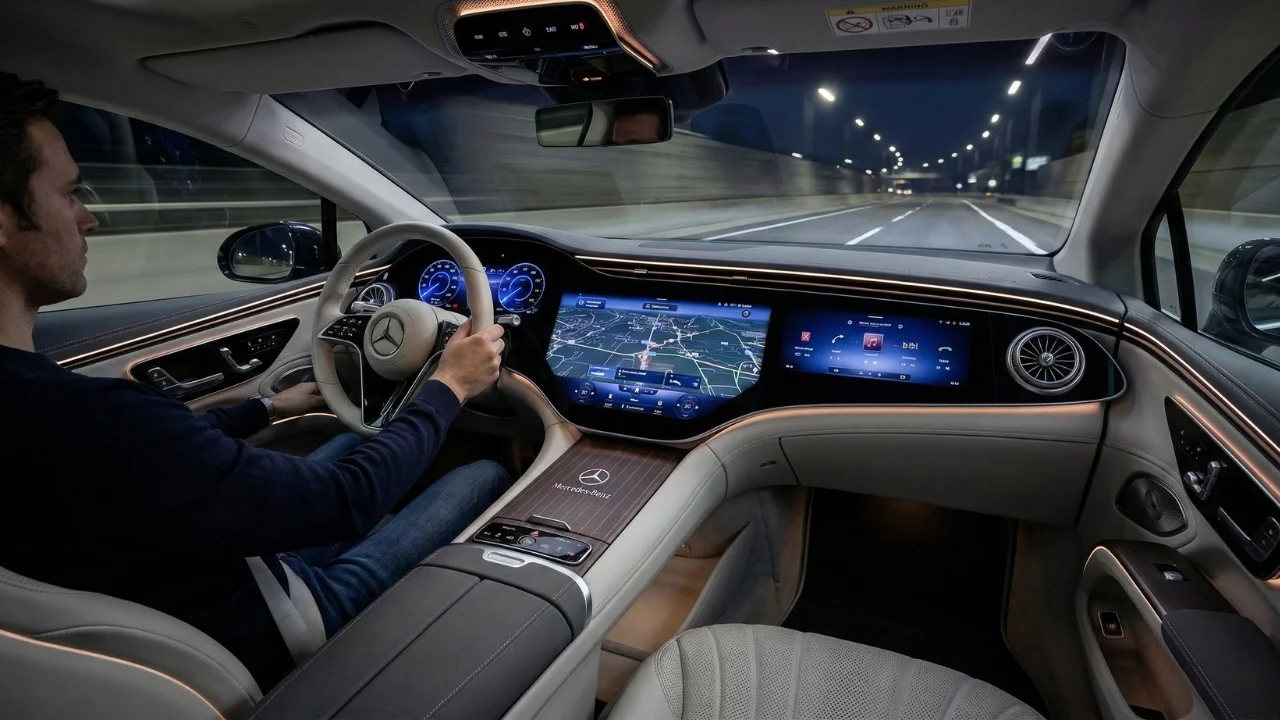
The MBUX Hyperscreen extends this further: its 56-inch curved glass panel — housing a 17.7-inch central OLED display, a 12.3-inch instrument cluster, and a 12.3-inch passenger OLED display — allows drivers and passengers to independently control their own zones simultaneously. This side-by-side independence is something Tesla’s single-screen architecture simply doesn’t offer. The passenger in a Mercedes-Benz can browse entertainment or adjust climate settings without interfering with the driver’s navigation or focus.
MBUX Hyperscreen — Display Specifications
| Display Zone | Screen Size | Technology | Function |
|---|---|---|---|
| Instrument Cluster | 12.3 inches | Digital Display | Speed, range, navigation, warnings |
| Central Infotainment | 17.7 inches | OLED Touchscreen | Navigation, media, climate, vehicle settings |
| Front Passenger Display | 12.3 inches | OLED Touchscreen | Independent entertainment, climate, seat controls |
| Glass Panel (Total) | 56 inches diagonal | Curved Gorilla Glass | Unified, seamless dashboard surface |
A System That Learns Over Time
The most sophisticated dimension of MBUX is its adaptive intelligence. Rather than offering static functionality, the system continuously analyzes behavior — frequently traveled routes, preferred climate settings, commonly accessed media, driving style — and uses that data to build a more personalized experience with every drive.
In practical terms, this means a driver commuting regularly from El Cajon to downtown San Diego might find that MBUX proactively offers traffic updates and alternate routes before they ask. On a rainy afternoon, the system may automatically adjust lighting and driving mode. If a calendar appointment suggests an upcoming destination, MBUX can surface navigation to that location at the appropriate time.
The machine learning behind these suggestions operates on a hybrid model — onboard processors handle real-time adaptation, while cloud connectivity supports deeper analysis and ongoing updates. This architecture allows MBUX to respond intelligently in the moment without compromising speed or security.
Tesla is frequently praised for its over-the-air software update cadence, which regularly introduces new features and improvements. Mercedes-Benz also delivers over-the-air updates, but MBUX’s advantage is less about update frequency and more about behavioral adaptation — learning the individual driver rather than just updating the platform.
The MBUX Hyperscreen — What It Adds
While MBUX is available across the Mercedes-Benz lineup in various configurations, the Hyperscreen represents the system at its most immersive. Available on the EQS Sedan, EQS SUV, EQE Sedan, and EQE SUV, the Hyperscreen replaces a traditional dashboard with a single curved glass panel spanning nearly the full width of the vehicle.
8 CPU Cores
Processing power dedicated to rendering graphics, managing AI algorithms, and supporting simultaneous multi-zone interactions without lag.
24GB RAM
46.4 GB/s of RAM bandwidth ensures fluid responsiveness across all three display zones in any driving scenario.
12 Haptic Actuators
Tactile feedback beneath the touchscreen surface replaces the feel of physical buttons for confident, distraction-free interaction.
For buyers in La Mesa and Chula Vista evaluating whether the Hyperscreen upgrade justifies the additional investment, the core question is how deeply they engage with in-vehicle technology. Drivers who rely heavily on voice, navigation, and connected services day to day will find the Hyperscreen’s capabilities make every interaction faster and more intuitive. Those with more straightforward needs may find the standard MBUX display — already a premium, capable system — fully sufficient.
Experience MBUX at Mercedes-Benz of El Cajon
The most direct way to evaluate MBUX is behind the wheel. Mercedes-Benz of El Cajon, located at 1111 Wagner Drive in El Cajon, CA, carries the latest Mercedes-Benz models featuring MBUX technology — including Hyperscreen-equipped EQ vehicles. Call our sales team at 888-881-6670 to ask about current availability or to schedule a personalized demonstration.
0 comment(s) so far on What Makes MBUX Different from Other Infotainment Systems