

2026 Mercedes-Benz C-Class vs E-Class: Which Sedan Is Right for You?
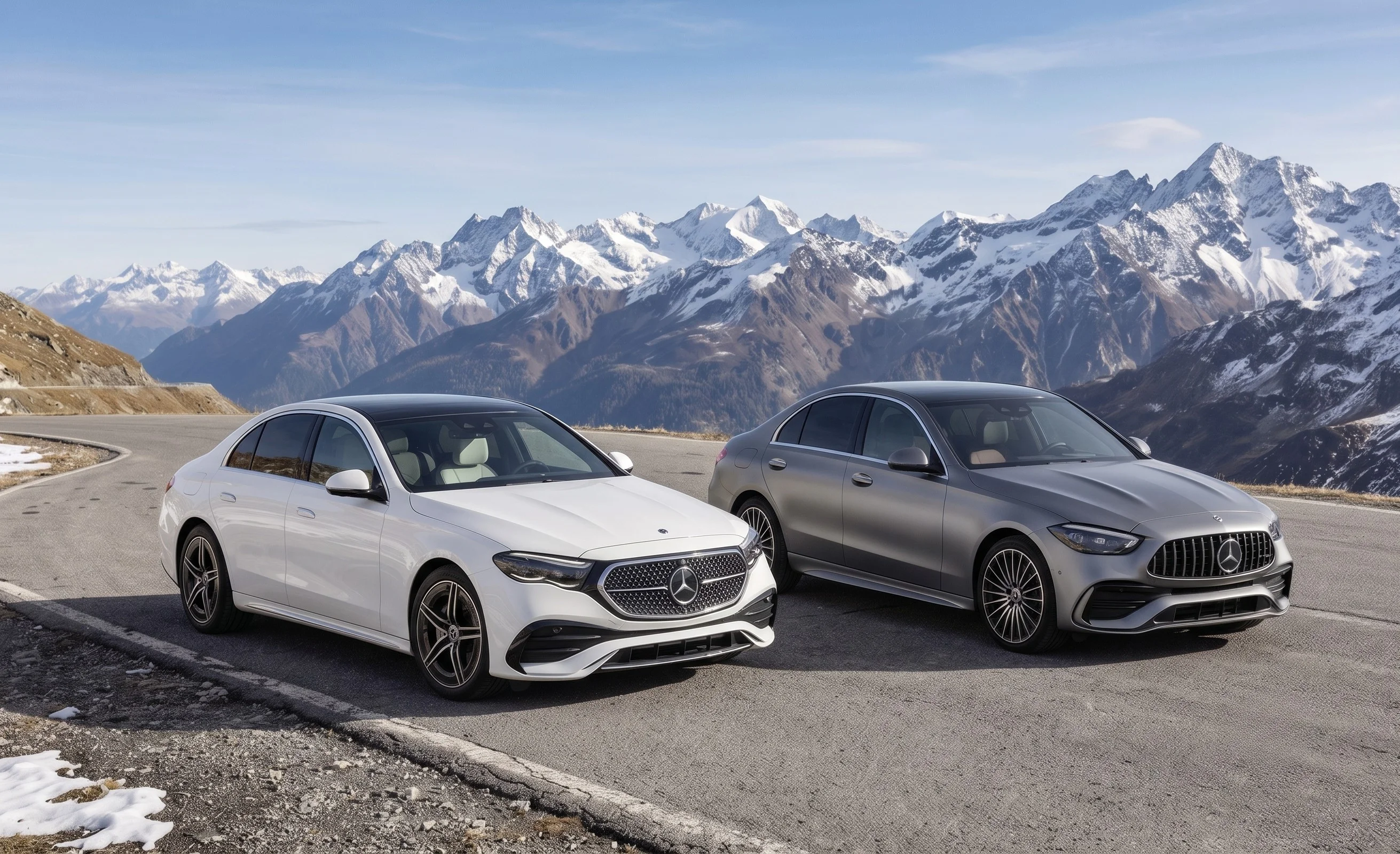
The 2026 Mercedes-Benz C-Class and the 2026 Mercedes-Benz E-Class sit one rung apart in the same lineup. For shoppers across El Cajon and the greater San Diego area, the decision usually comes down to one question: do you want the more agile, better-value compact executive sedan, or the larger, more serene midsize flagship? This comparison breaks down pricing, powertrains, fuel economy, space, technology, and safety so you can decide which Mercedes-Benz sedan fits your driving life.
Both sedans share the brand’s design language, its latest MBUX cabin technology, and its core suite of driver-assistance systems. Where they separate is size and character. The C-Class is the compact, driver-focused sedan that borrows heavily from the flagship S-Class in a tidier footprint. The E-Class is the larger executive platform, with more rear space, a bigger central screen, and an available plug-in hybrid at the top of its range. You can dig deeper into each model’s full lineup on our 2026 Mercedes-Benz C-Class specs and trims and 2026 Mercedes-Benz E-Class overview pages.
Pricing and Value
On price, the C-Class is the clear entry point. The lineup opens with the rear-wheel-drive C 300 and the all-wheel-drive C 300 4MATIC®, then steps up to the Mercedes-AMG C 43. The E-Class starts higher with the rear-wheel-drive E 350 and climbs through the E 450 to the plug-in-hybrid Mercedes-AMG E 53.
| Trim | MSRP |
|---|---|
| C 300 (RWD) | $51,000 |
| C 300 4MATIC® | $53,000 |
| Mercedes-AMG C 43 | $65,500 |
| E 350 (RWD) | $65,250 |
| E 450 4MATIC® | $73,650 |
| Mercedes-AMG E 53 | $90,950 |
Manufacturer’s Suggested Retail Price (MSRP) for new vehicles includes manufacturer and distributor options and delivery, process and handling fees, which may be subject to change at any time. MSRP excludes taxes, title, license and dealer installed options, accessories, fees and charges. MSRP is not the dealer advertised price. Dealer price will vary. The dealer sets the final price.
The takeaway for value-focused shoppers is straightforward: a C-Class C 300 starts below the least expensive E-Class, and even the performance-oriented Mercedes-AMG C 43 lands below the six-cylinder E 450. That gap lets C-Class buyers redirect budget toward option packages such as the Pinnacle Trim Package or the Driver Assistance Package while keeping the total lower than a comparably equipped E-Class. The C-Class range does climb higher at the very top — the 671-horsepower plug-in-hybrid Mercedes-AMG C 63 S E Performance starts around $89,000 — but most shoppers cross-shopping the two lines are weighing the C 300 and Mercedes-AMG C 43 against the E-Class trims below.
Performance and Powertrains
Both base cars use the same fundamentals: a turbocharged 2.0-liter four-cylinder with 48-volt mild-hybrid assist producing 255 horsepower in the C 300 and E 350. From there the two families diverge sharply at the top.
| Specification | Mercedes-AMG C 43 | Mercedes-AMG E 53 |
|---|---|---|
| Engine | Handcrafted 2.0L inline-4 turbo + hybrid assist | 3.0L inline-6 turbo + electric motor (plug-in hybrid) |
| Horsepower | 416 hp | 577 hp (combined) |
| Torque | 369 lb-ft | 553 lb-ft (combined) |
| Drivetrain | AMG Performance 4MATIC® all-wheel drive | AMG Performance 4MATIC®+ all-wheel drive |
| Transmission | 9-speed automatic | 9-speed automatic |
The Mercedes-AMG C 43 uses a handcrafted 2.0-liter four-cylinder with hybrid assist and an electric exhaust-gas turbocharger, producing 416 horsepower and 369 lb-ft of torque through a nine-speed automatic and standard AMG Performance 4MATIC® all-wheel drive. It also adds rear-axle steering and adaptive damping for sharper handling.
The Mercedes-AMG E 53 goes further, pairing a turbocharged 3.0-liter inline-six with an electric motor in a plug-in-hybrid setup that delivers a combined 577 horsepower and 553 lb-ft of torque. The E-Class trades the C-Class’s lower curb weight for straight-line muscle and the ability to run on electricity alone for short commutes. If you want a lighter, more nimble sport sedan, the C-Class is the pick; if you want maximum power and an electric-commute option, the Mercedes-AMG E 53 answers that.
EPA-Estimated Fuel Economy
For efficiency, the mainstream C-Class trims lead. The rear-wheel-drive C 300 is the mileage leader of the group, while the C 300 4MATIC® gives up only a little for all-weather traction. Among the six-cylinder and performance trims, the E 450 and the AMG models trade efficiency for output, and the Mercedes-AMG E 53 adds a meaningful all-electric range that can cover many daily commutes before the gas engine is needed.
| Trim | EPA-Est. City | EPA-Est. Highway | EPA-Est. Combined |
|---|---|---|---|
| C 300 (RWD) | 25 | 35 | 29 |
| C 300 4MATIC® | 24 | 33 | 27 |
| Mercedes-AMG C 43 | 19 | 27 | 22 |
| E 350 (RWD) | 25 | 33 | 28 |
| E 450 4MATIC® | 22 | 31 | 25 |
| Mercedes-AMG E 53 | 54 (MPGe) | 65 (MPGe) | 59 (MPGe) |
The Mercedes-AMG E 53 is a plug-in hybrid, so its EPA rating is shown in MPGe (miles per gallon of gasoline-equivalent), which combines electric and gasoline operation. On gasoline alone it is EPA-estimated at 23 mpg combined, and it offers up to an EPA-estimated 43 miles of all-electric driving range.
EPA-estimated fuel economy figures are for comparison purposes only. Your actual mileage will vary depending on driving conditions, how you drive and maintain your vehicle, battery age/condition, and other factors.
Space and Comfort
Both sedans seat five, but the E-Class uses its larger body to offer more room and a slightly bigger trunk, which matters if you regularly carry strollers, luggage, or gear for the whole family. The C-Class counters with a lower curb weight and a more compact footprint that make it easier to place in tight parking structures and city streets.
| Specification | C-Class | E-Class |
|---|---|---|
| Seating | 5 | 5 |
| Cargo (trunk) | 11.6 cu ft | 12.7 cu ft (sedan) |
| Curb weight | 4,165 lbs (Mercedes-AMG C 43) | 5,337 lbs (Mercedes-AMG E 53, as measured by Edmunds) |
The Mercedes-AMG E 53’s plug-in-hybrid battery pack adds significant mass: independent instrumented testing by Edmunds has measured the current E 53 sedan at roughly 5,337 pounds — well over 1,000 pounds heavier than the four-cylinder Mercedes-AMG C 43 — which is a big reason the C-Class feels lighter and more agile behind the wheel.
In short, the E-Class is the better long-distance and family-hauling cruiser, while the C-Class is the easier daily companion for shorter, busier drives around town.
Technology
Inside, the C-Class brings an S-Class-inspired layout: a standard 12.3-inch digital instrument cluster paired with an 11.9-inch portrait-oriented central touchscreen that is tilted six degrees toward the driver. Wireless Apple CarPlay® and Android Auto™ are standard, along with a biometric fingerprint scanner that loads your personal profile and seat memory.
The E-Class starts with a larger 14.4-inch central touchscreen and offers the available MBUX Superscreen Package, which extends the glass across the passenger side of the dashboard, adding a 12.3-inch front-passenger display and a selfie and video camera. The Superscreen is the more theatrical setup; the C-Class’s driver-angled portrait screen keeps controls close and simple. Both run the same generation of MBUX, so the core experience carries across either sedan.
Safety
Mercedes-Benz equips both the C-Class and the E-Class with a comprehensive suite of active safety technology. Standard features on both include Active Brake Assist, Blind Spot Assist with Exit Warning Assist, ATTENTION ASSIST®, and the PRE-SAFE® and PRE-SAFE® Sound systems. The C-Class includes a front-center airbag that deploys between the driver and front passenger to reduce head-to-head contact in a side impact. On both models, the available Driver Assistance Package adds Active Distance Assist DISTRONIC®, Active Steering Assist, and Evasive Steering Assist for added confidence in traffic.
Frequently Asked Questions
Is the 2026 Mercedes-Benz C-Class worth choosing over the E-Class for the price?
For many shoppers, yes. The C-Class delivers the same generation of MBUX technology, the same core standard safety systems, and Mercedes-Benz cabin quality at a lower entry price, which frees up budget for higher trims or option packages while staying within reach.
Which sedan is more fuel-efficient for daily driving?
Among the mainstream trims, the C-Class leads. The rear-wheel-drive C 300 posts the best EPA-estimated combined figure in this comparison, and the C 300 4MATIC® follows closely while adding all-wheel-drive traction. The E 350 is competitive, and the Mercedes-AMG E 53 offers all-electric range for those who charge regularly.
Which model is easier to maneuver and park?
The C-Class. Its more compact dimensions and lower curb weight make it easier to handle in tight parking lots and busy streets, and the Mercedes-AMG C 43 adds rear-axle steering that further tightens low-speed maneuverability.
How can I compare these sedans in person?
Visit Mercedes-Benz of El Cajon at 1111 Wagner Drive in El Cajon to see both models side by side, or schedule a test drive online to experience each one on your own routes.
The Verdict
For drivers who want an agile, tech-rich luxury sedan at the more accessible end of the Mercedes-Benz range, the 2026 C-Class is the smarter buy: it condenses much of the brand’s flagship design and technology into a lighter, easier-to-live-with footprint, and it starts well below the E-Class. If your priority is maximum interior space, the most serene highway ride, the biggest cabin screens, or the all-electric commuting range of the Mercedes-AMG E 53, the 2026 E-Class earns the premium. Either way, both are available now at Mercedes-Benz of El Cajon.
Disclaimers
Manufacturer’s Suggested Retail Price (MSRP) for new vehicles includes manufacturer and distributor options and delivery, process and handling fees, which may be subject to change at any time. MSRP excludes taxes, title, license and dealer installed options, accessories, fees and charges. MSRP is not the dealer advertised price. Dealer price will vary. The dealer sets the final price.
EPA-estimated fuel economy figures are for comparison purposes only. Your actual mileage will vary depending on driving conditions, how you drive and maintain your vehicle, battery age/condition, and other factors.